/ Mar 09, 2026
Trending
Writing a good book is something every fiction writer aspires to. When writers ask for help writing a book, a popular question is ‘Is my idea good enough?’ Having a great story idea to start with helps. Yet a satisfying novel is a combination of many key components. Here are 10 ingredients that will make your book better:
Your story idea doesn’t have to be the most exciting concept the world has ever seen. Virginia Woolf’s classic modernist novel Mrs Dalloway is about a woman planning and hosting a party. A simple premise. What’s made it endure (and be taught in universities) is its rich, complex grasp of character, among other aspects.
So readers may forgive a non-thrilling premise. Few, though, will forgive a disappointing first paragraph. Think of some of the openings of some of the best-loved novels of all time. They create intrigue. George Orwell, for example, opens 1984 (1949) with the words:
It was a bright day in April and the clocks were striking thirteen.
The reader immediately has questions: What clocks? Why thirteen, rather than the usual twelve chimes? Orwell immediately creates questions in the reader and anchors them in a key aspect of setting – time. Another example of a great opening is Toni Morrison’s first sentence in her haunting, Pulitzer-winning novel Beloved (1987). Morrison opens the book with just 3 words:
124 was spiteful.
What is 124? Why is this mysterious number described as spiteful? The reader learns that it is the street number for the house where some of the novel’s tragedy takes place.
To test whether the opening of your novel is strong enough, ask yourself these questions:
What makes a good story? One aspect of this is style. Writers are often told to avoid adverbs (instead of ‘ran hurriedly’ say ‘sprinted’ or ‘dashed’, for example). This is not because adverbs are ‘bad’, necessarily, but because often more descriptive verbs are available.
Something more abstract is equally important in style: rhythm.
Why is rhythm important? Because the cadence of words, the way they sound to the inner ear, is what makes some sentences more beautiful and memorable than others. Consider poetry: Besides striking imagery and metaphors, what gives poetry its ‘poetic’ quality is the rhythm the words create.
In a taut thriller, the rhythm of the prose may be fast and clipped, whereas in a lyrical historical epic, the writing might flow smoothly in long, ebbing and flowing sentences.
A good understanding for how to use the rhythm of a sentence itself in interesting ways will make your writing more interesting to read. One way to develop this rhythmic skill is to read sentences and paragraphs aloud sometimes (even if it makes you feel silly).
Once you’ve hooked your reader’s attention, you will need to sustain their interest. Plot and character development are crucial. Yet to let readers fully enter your fictional world, you also need to arrest the reader’s imagination with vivid and powerful description.
Forgettable books often have thin description, with the bare minimum indicating setting.
By contrast, here is the rich description of the badger’s home in Kenneth Grahame’s classic children’s book, The Wind in the Willows (1908):
‘In the middle of the room stood a long table of plain boards placed on trestles, with benches down each side. At one end of it, where an arm-chair stood pushed back, were spread the remains of the Badger’s plain but ample supper. Rows of spotless plates winked from the shelves of the dresser at the far end of the room, and from the rafters overhead hung hams, bundles of dried herbs, nets of onions, and baskets of eggs.’
Grahame conjures an intimate and cozy dwelling. The verb ‘winked’ Grahame uses to describe the gleaming plates is well-chosen. It suggests a fitting mood of friendliness, familiarity and intimacy in Badger’s comforting home.
When writing description, remember to:
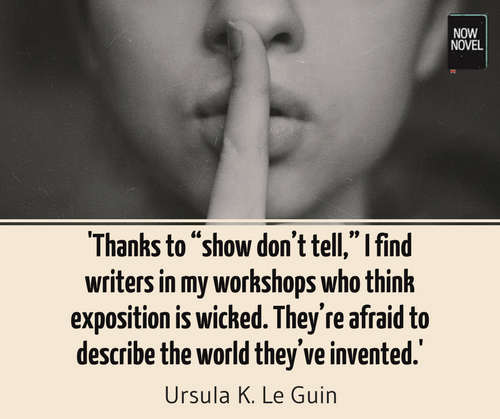
The saying ‘show, don’t tell’ is one of the most abused and misused pieces of writing advice. As Ursula K. Le Guin states, if taken to heart it can inhibit you from describing at all. Says Le Guin:
‘Thanks to “show don’t tell,” I find writers in my workshops who think exposition is wicked. They’re afraid to describe the world they’ve invented.’
The truth is that some telling is necessary: Tell your reader what your world looks like.
It’s neither better to show nor tell: It depends on whether action or description is best suited to your particular story at any particular point in your narrative. As Le Guin says, ‘dread of writing a sentence that isn’t crammed with “gutwrenching action” leads fiction writers to rely far too much on dialogue, to restrict voice to limited third person and tense to the present.’
When you’re worried that you’re telling too much and showing too little, ask:
Sometimes you are too close to your own writing to know whether you’re striking the right balance between showing and telling. This is where it helps to get feedback from other writers.
Writing a good book also requires skilled characterization.
Some genres do allow characters that resemble cardboard cutouts. In a typical James Bond story, a bond girl is always a bond girl. A suave assassin is always the typical suave assassin. More interesting installments in Ian Fleming’s franchise have been those where the hero displays a surprising vulnerability or the ‘bond girl’ is more than a sex symbol. The story doesn’t only peddle worn out tropes.
To make your characters diverse and well-developed, do at least some of the following:
What do many of the best-loved movies of all time have in common? Memorable dialogue.
If you pay attention, characters in great novels and movies don’t talk as we do in real life. We might say ‘um’ a lot, or repeat ourselves, or make small-talk that would be completely mundane to anyone listening in. Writing a good book demands that even incidental dialogue serves the story. So what does script-worthy dialogue do? It:
This third point is the ‘subtext’ of dialogue – the reasons, feelings, suspicions (and so forth) underlying characters’ conversations. Thinking about detail such as this and incorporating it in your dialogue sometimes will add depth and dimension. Why does a character not look another in the eyes while telling them an extremely important fact? What does the combination of speech, gesture, posture, movement tell your reader?
One of the most common features of ‘bad’ writing is that the story makes no overarching sense. Maybe the heroine’s actions completely contradict her psychological description and backstory. Or else there are sequences of scenes that don’t seem to contribute cohesively to the whole.
To ensure your novel has strong inner logic:
Whatever you want to call it – rising action and falling action or build-up and climax – tension and release keep readers invested in the outcome of your novel. Because balancing action and tension release is key:
Many of the landmark novels of the last few centuries have built on their predecessors but also offered something new. Even though Jean Rhys’ Wide Sargasso Sea (1966) tells the story of a secondary character from Charlotte Brontë’s novel Jane Eyre, Rhys uses this to tell her own story about gender and racial politics.
In doing so, Rhys recombines existing characters and existing worlds into something entirely her own.
To stay original make sure that you:
One of the biggest disappointments, many readers will agree, is when a writer lets a story peter out and does not do justice to the story’s central idea. Many writers use anti-climax to subtle effect. In Kazuo Ishiguro’s surreal novel The Unconsoled (1995), the reader is made to expect a significant event that never happens.
To make sure your ending is satisfying:
Writing a good book is something every fiction writer aspires to. When writers ask for help writing a book, a popular question is ‘Is my idea good enough?’ Having a great story idea to start with helps. Yet a satisfying novel is a combination of many key components. Here are 10 ingredients that will make your book better:
Your story idea doesn’t have to be the most exciting concept the world has ever seen. Virginia Woolf’s classic modernist novel Mrs Dalloway is about a woman planning and hosting a party. A simple premise. What’s made it endure (and be taught in universities) is its rich, complex grasp of character, among other aspects.
So readers may forgive a non-thrilling premise. Few, though, will forgive a disappointing first paragraph. Think of some of the openings of some of the best-loved novels of all time. They create intrigue. George Orwell, for example, opens 1984 (1949) with the words:
It was a bright day in April and the clocks were striking thirteen.
The reader immediately has questions: What clocks? Why thirteen, rather than the usual twelve chimes? Orwell immediately creates questions in the reader and anchors them in a key aspect of setting – time. Another example of a great opening is Toni Morrison’s first sentence in her haunting, Pulitzer-winning novel Beloved (1987). Morrison opens the book with just 3 words:
124 was spiteful.
What is 124? Why is this mysterious number described as spiteful? The reader learns that it is the street number for the house where some of the novel’s tragedy takes place.
To test whether the opening of your novel is strong enough, ask yourself these questions:
What makes a good story? One aspect of this is style. Writers are often told to avoid adverbs (instead of ‘ran hurriedly’ say ‘sprinted’ or ‘dashed’, for example). This is not because adverbs are ‘bad’, necessarily, but because often more descriptive verbs are available.
Something more abstract is equally important in style: rhythm.
Why is rhythm important? Because the cadence of words, the way they sound to the inner ear, is what makes some sentences more beautiful and memorable than others. Consider poetry: Besides striking imagery and metaphors, what gives poetry its ‘poetic’ quality is the rhythm the words create.
In a taut thriller, the rhythm of the prose may be fast and clipped, whereas in a lyrical historical epic, the writing might flow smoothly in long, ebbing and flowing sentences.
A good understanding for how to use the rhythm of a sentence itself in interesting ways will make your writing more interesting to read. One way to develop this rhythmic skill is to read sentences and paragraphs aloud sometimes (even if it makes you feel silly).
Once you’ve hooked your reader’s attention, you will need to sustain their interest. Plot and character development are crucial. Yet to let readers fully enter your fictional world, you also need to arrest the reader’s imagination with vivid and powerful description.
Forgettable books often have thin description, with the bare minimum indicating setting.
By contrast, here is the rich description of the badger’s home in Kenneth Grahame’s classic children’s book, The Wind in the Willows (1908):
‘In the middle of the room stood a long table of plain boards placed on trestles, with benches down each side. At one end of it, where an arm-chair stood pushed back, were spread the remains of the Badger’s plain but ample supper. Rows of spotless plates winked from the shelves of the dresser at the far end of the room, and from the rafters overhead hung hams, bundles of dried herbs, nets of onions, and baskets of eggs.’
Grahame conjures an intimate and cozy dwelling. The verb ‘winked’ Grahame uses to describe the gleaming plates is well-chosen. It suggests a fitting mood of friendliness, familiarity and intimacy in Badger’s comforting home.
When writing description, remember to:
The saying ‘show, don’t tell’ is one of the most abused and misused pieces of writing advice. As Ursula K. Le Guin states, if taken to heart it can inhibit you from describing at all. Says Le Guin:
‘Thanks to “show don’t tell,” I find writers in my workshops who think exposition is wicked. They’re afraid to describe the world they’ve invented.’
The truth is that some telling is necessary: Tell your reader what your world looks like.
It’s neither better to show nor tell: It depends on whether action or description is best suited to your particular story at any particular point in your narrative. As Le Guin says, ‘dread of writing a sentence that isn’t crammed with “gutwrenching action” leads fiction writers to rely far too much on dialogue, to restrict voice to limited third person and tense to the present.’
When you’re worried that you’re telling too much and showing too little, ask:
Sometimes you are too close to your own writing to know whether you’re striking the right balance between showing and telling. This is where it helps to get feedback from other writers.
Writing a good book also requires skilled characterization.
Some genres do allow characters that resemble cardboard cutouts. In a typical James Bond story, a bond girl is always a bond girl. A suave assassin is always the typical suave assassin. More interesting installments in Ian Fleming’s franchise have been those where the hero displays a surprising vulnerability or the ‘bond girl’ is more than a sex symbol. The story doesn’t only peddle worn out tropes.
To make your characters diverse and well-developed, do at least some of the following:
What do many of the best-loved movies of all time have in common? Memorable dialogue.
If you pay attention, characters in great novels and movies don’t talk as we do in real life. We might say ‘um’ a lot, or repeat ourselves, or make small-talk that would be completely mundane to anyone listening in. Writing a good book demands that even incidental dialogue serves the story. So what does script-worthy dialogue do? It:
This third point is the ‘subtext’ of dialogue – the reasons, feelings, suspicions (and so forth) underlying characters’ conversations. Thinking about detail such as this and incorporating it in your dialogue sometimes will add depth and dimension. Why does a character not look another in the eyes while telling them an extremely important fact? What does the combination of speech, gesture, posture, movement tell your reader?
One of the most common features of ‘bad’ writing is that the story makes no overarching sense. Maybe the heroine’s actions completely contradict her psychological description and backstory. Or else there are sequences of scenes that don’t seem to contribute cohesively to the whole.
To ensure your novel has strong inner logic:
Whatever you want to call it – rising action and falling action or build-up and climax – tension and release keep readers invested in the outcome of your novel. Because balancing action and tension release is key:
Many of the landmark novels of the last few centuries have built on their predecessors but also offered something new. Even though Jean Rhys’ Wide Sargasso Sea (1966) tells the story of a secondary character from Charlotte Brontë’s novel Jane Eyre, Rhys uses this to tell her own story about gender and racial politics.
In doing so, Rhys recombines existing characters and existing worlds into something entirely her own.
To stay original make sure that you:
One of the biggest disappointments, many readers will agree, is when a writer lets a story peter out and does not do justice to the story’s central idea. Many writers use anti-climax to subtle effect. In Kazuo Ishiguro’s surreal novel The Unconsoled (1995), the reader is made to expect a significant event that never happens.
To make sure your ending is satisfying: