/ Oct 07, 2026
Trending
So you’ve finished your book… now what? Self-editing is what. Now it’s time to learn how to self-edit it—and properly.
Finishing the first draft of a book is a tremendous accomplishment that’s certainly worth celebrating. But it doesn’t get any easier from here.
The next step is one of the most tedious and important aspects of publishing a book—self-editing.
Sure, almost all self-published authors will hire an editor in some capacity. Before that step, you do have to edit the book yourself and only yourself (unless you use Scrivener footnotes editor or other editing tools, that is).
Here’s our guide to self-editing your novel:
At the very least, every author will receive feedback from multiple readers before the launch date, but self-editing is key because eliminating obvious errors and minimizing mistakes in the manuscript will give hired editors and beta readers a greater opportunity to provide corrections on the things you missed.
After completing a rough draft, it’s very tempting to immediately hire an editor and hand over your manuscript. But no writer can state their rough draft is the very best of their work.
And after all, the better the draft you submit to an editor, the better final product.
An editor will surely help improve a manuscript, but before placing that rough draft in an editor’s hands, each writer should be able to answer yes to the question:
“Did I make this manuscript as strong and as good as I could have?”
There’s no way the answer to that question is yes after only writing
the rough draft. Take pride in your work and make sure it’s your best
before someone else reads it.
Before beginning the self-editing phase, there are three important things to keep in mind:
Editing and Revising sound very similar, but knowing the subtle differences can make self-editing a lot easier.
Throughout my career, I’ve engaged in a lot of different writing styles. Depending on the outlet and audience, writing style may differ, but one constant is all writing needs edited and revised in some capacity.
Of course, one of the most essential parts of the self-editing phase is knowing the difference between editing and revising. I’ll lay out the subtle difference and explain how to achieve both in order to turn your rough draft into a sparkling text for your editor.
Editing and Revising definitions according to the Merriam-Webster Dictionary
Editing – to prepare for publication or public presentation; to alter, adapt, or refine especially to bring about conformity to a standard or to suit a particular purpose.
Revising – to look over again in order to correct or improve; to make a new, amended, improved, or up-to-date version of
On the surface, they sound exactly the same. To be fair, editing and revising are similar, but not exactly the same thing.
In a basic nutshell, editing is fixing basic errors like
capitalization, punctuation and spelling. Revising is the act of
improving specific writing such as sentence structure, chapter structure
and word choice.
A good self-edit will include both edits and revisions to a manuscript.
Before getting started with self-editing, though, keep in mind that
Self-Publishing School advises not to wait, but to reach out and/or hire
an editor after you finish your manuscript. Performing that task upon
completing the rough draft will allow the author to hand over their
manuscript right after finishing the self-editing phase.
Editors are often booked two weeks in advance. Waiting to reach out
to editors until after the self-edit could mean there’s no movement on
your book for at least a couple weeks.
Now you’re ready to begin.
The self-editing phase will include re-reading your book at least
three times. Self-Publishing School calls them verbal read-throughs.
With each one, you will be looking to address different aspects of your
writing.
In the self-edit of my own first book, I devised three different types of read-throughs.
The three different types of verbal read-throughs in self-editing:
Each read-through during self-editing should be done out loud.
Self-Publishing School teaches to read your manuscript out loud to
yourself. I couldn’t agree more. It may seem a little silly, but it’s
much easier to find errors while reading the entire book out loud than
silently.
Find a quiet spot alone so you can read out loud.
Following my three different types of read-throughs and reading them out loud will enable you to make your book as good as you can.
Remember that great mind map and book outline you constructed before even beginning to write the rough draft? It’s time to break those back out.
As you begin to re-read your manuscript chapter-by-chapter, follow along with your outline as well. This will allow you to make sure every detail is in the right place and nothing is missing.
This is how you can structure your self-edits for chapters:
Those chapters on your outline and in your book should all have a
clear and concise topic. In some ways, one could think of the individual
chapters as their own little books. Each one connects to the others,
but they can also stand alone.
Double checking chapter structure is the first real key to self-editing.
One personal example of how revising chapter structure helped my book:
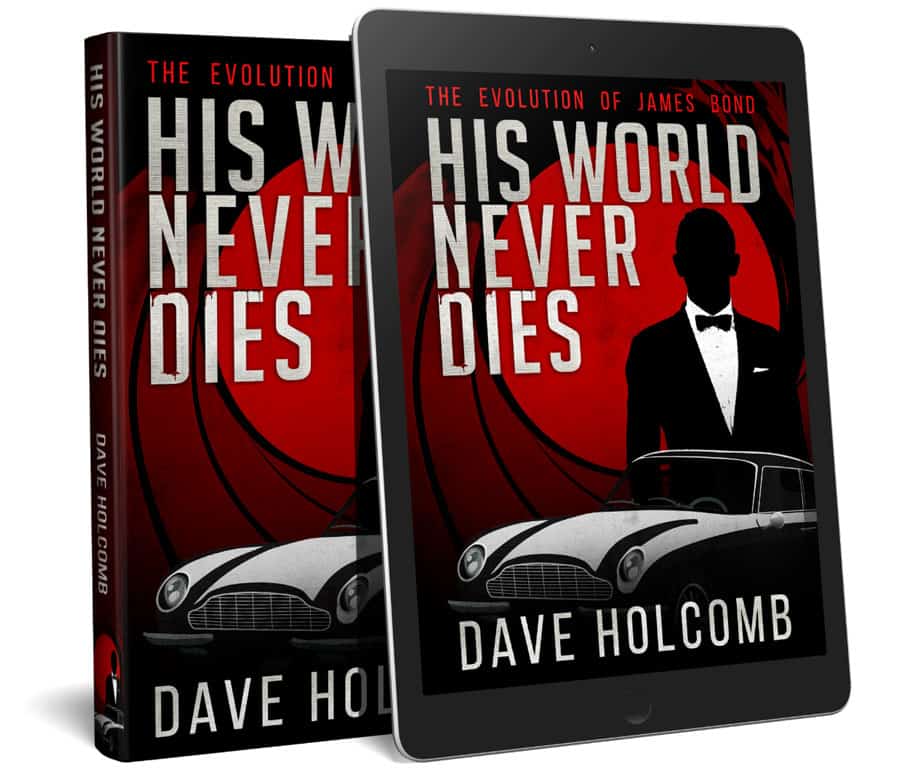
In my own rough draft, the first chapter of my book, His World Never Dies: The Evolution of James Bond, explored the popularity of the Bond film series and how the series’ portrayal of masculinity has changed over the years.
When I devised my outline, it seemed natural that these two topics
were tied together since Bond’s masculinity is why so many men and women
have enjoyed the series over the last six decades.
But I had two problems: the chapter was more than
4,500 words while the other nine chapters in my book were all around
3,000. Even worse, the first chapter bounced between these two ideas
that I thought were connected—Bond’s popularity and masculinity.
Upon my read-through, the chapter felt clunky and long. If readers
shared the same sentiment, they might not continue to read the rest of
the book.
In self-editing, make sure each chapter has one clear and concise topic.
Revisions were needed. It took a lot of work, but I divided the first
chapter into two — one that focused on the series’ popularity and the
other on Bond’s masculinity. After I made this decision, I read through
the entire chapter again, picking out which paragraphs applied to which
specific topic.
Following that step, the two new chapters were too short, which meant both needed more words. I had more writing to do.
But by dividing the chapter, rearranging the paragraphs and adding more details, I had made some very strong revisions.
I now possessed two chapters that started my book on the right track — with each chapter standing alone and focused on one topic.
This is how to go through self-editing for sentence structure & transitions:
Double checking sentence structure is the second important part of step one in self-editing.
How each book idea flows to the next is the second aspect to consider during the “structure” read-through. The use of transition words and phrases—next, then, furthermore, on the other hand, etc.—can be very helpful to achieve this.
But the same concepts to ensuring chapter structure should be applied
to sentence structure. Make sure to complete your entire thought on one
subject before jumping to the next whether from chapter to chapter or
inside a chapter.
Proper transitions and book flow will allow readers to keep going naturally. It could prevent them from ever putting it down!
It’s very likely that you know your book topic better than anyone who reads your book. That’s especially true if you are writing a memoir, but that will likely also be the case with a self-help book or non-fiction commentary on something such as the James Bond film series.
After double checking the structure of your book, the second read-through should ensure every chapter, every paragraph, every sentence and even every word makes sense.
Ask yourself these questions when editing for vague details or over-explained thoughts:
Keep these questions in mind during the second read-through of the self-editing stage.
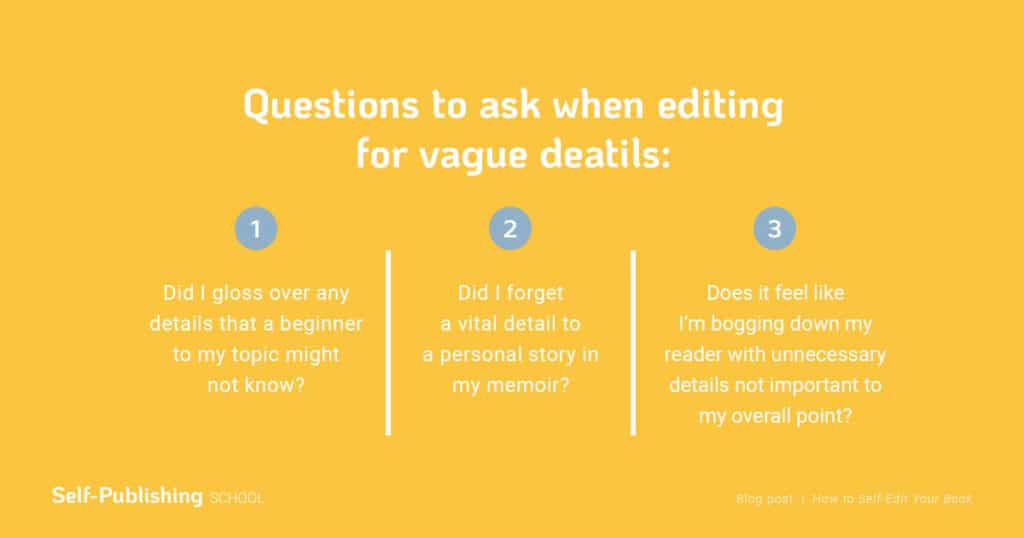
In the second read-through, place yourself in the mind of your reader.
For my book, I needed to ensure every scene of a Bond film I explain was properly detailed to my audience. I have seen the Bond movies dozens of times, but not every reader will have, so it was important to make sure even readers who haven’t seen the films can understand what’s going on in a particular scene.
Here’s how to self-edit awkward phrasing:
In this step, authors should also be able to find awkward phrasing. This is the biggest reason why we advise reading your manuscript out loud. Sentences that don’t make sense or that need to be reworded will stick out when spoken in voice rather than read silently.
As you may have guessed, the first two read-through steps are making
revisions to your manuscript. In this last step, authors will be
performing both edits and revisions.
Once you’ve nailed down your book’s structure and readability, you’re
now ready to double check grammar, spelling, capitalization and
punctuation.
It’s important to leave grammar until the last step of the
self-editing phase. Otherwise, you will need to repeat this step after
revisions are complete.
Double checking word choice was vitally important in my own self-editing.
I tend to repeat the same words without even realizing. In my first
rough draft, I had the same transition word used multiple times on the
same page or the same verb or adjective deployed on numerous occasions
in the same chapter.
Get out a thesaurus and utilize different words where
applicable—just be sure these words actually make sense (as we all know
thesauruses can’t always be trusted).
This doesn’t mean change every noun to a fancier word in attempt to sound smart. Nobody likes a smart ass. But avoiding repeated words while expanding your vocabulary in a colloquial way is the last step in self-editing.
Other tips for self-edit read-throughs:
That’s the end of the actually steps needed to complete the self-editing phase, but there’s more to it than just simply reading through the manuscript and making alterations.
Are you more of a paper and pen person or do you love using track changes on writing software like Microsoft Word or Google Docs?
There is no right or wrong, but finding your best preference and
consistently repeating it through each read-through is essentially.
Personally, I loved the good, old-fashioned pen and paper for my self-editing. I find it easier to read out loud from a paper than a screen. It also allowed me to easily keep track of all my edits and revisions with a pen.
You can do the same, though, with track changes like in the example below.
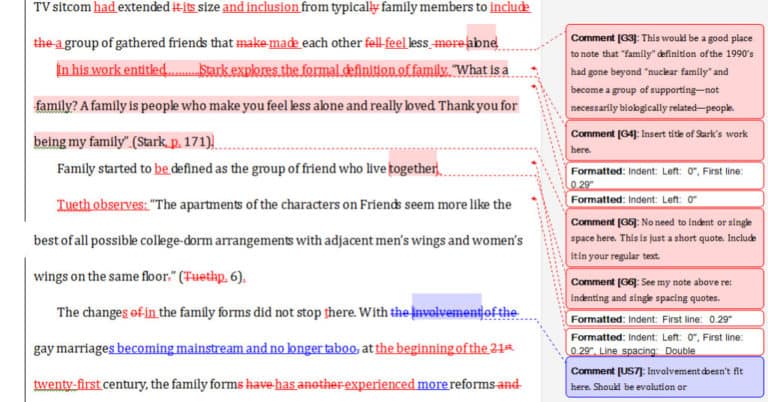
Printing out your manuscript and/or working with track changes is essential to the self-editing phase.
After each read-through, make the changes in your official
manuscript, so they are present for the next read-through. Then repeat
the process.
For all the read-throughs, I would print out a new copy of my book.
NOTE: To save paper, reprint on the back of the previous manuscript.
Most self-published authors have other jobs. If not, they still likely have very busy lives because everyone does. That probably makes performing an entire read-through for the whole book in one sitting very unlikely.
However, there are advantages to self-editing the whole book in one read-through during a single day.
Reading the entire manuscript together for chapter and sentence
structure is a good idea because it’s easier to get the entire picture
of how the book fits together.
It’s also easier to pick out repeated phrases and words. If you wait
several days between reading the first and final chapter for structure,
you may not realize you repeat yourself too much or that you have the
exact same sentence in two places.
The readers that never put your book down may experience it in an entirely different way than you did if you never performed an entire book read-through in one sitting.
There are plenty of advantages to only re-reading a chapter at a time as well. For one, going through an entire read-through in one sitting can take hours and is very tiring. In the last few chapters, you might not be as sharp at catching errors as you were at the beginning of the process because of fatigue.
All self-editing can be tedious, but checking for grammar, spelling
and punctuation is particularly banal. It’s even harder when tired.
Furthermore, if the goal is to get through the entire book with one
read-through in one sitting, but you only have a set amount of time to
do it, there’s a distinct possibility that you will rush. That’s not a
good thing either.
TIP: Try both techniques to see which self-editing works for you.
The one-sitting read-through is better suited for when
checking for structure. It’s better to read one chapter at a time while
editing for grammar and spelling.
If your book is truly too long for a read-through in one sitting, then don’t worry about it. More than likely, that means readers won’t be reading it all the way through at a time either.
So you’ve finished your book… now what? Self-editing is what. Now it’s time to learn how to self-edit it—and properly.
Finishing the first draft of a book is a tremendous accomplishment that’s certainly worth celebrating. But it doesn’t get any easier from here.
The next step is one of the most tedious and important aspects of publishing a book—self-editing.
Sure, almost all self-published authors will hire an editor in some capacity. Before that step, you do have to edit the book yourself and only yourself (unless you use Scrivener footnotes editor or other editing tools, that is).
Here’s our guide to self-editing your novel:
At the very least, every author will receive feedback from multiple readers before the launch date, but self-editing is key because eliminating obvious errors and minimizing mistakes in the manuscript will give hired editors and beta readers a greater opportunity to provide corrections on the things you missed.
After completing a rough draft, it’s very tempting to immediately hire an editor and hand over your manuscript. But no writer can state their rough draft is the very best of their work.
And after all, the better the draft you submit to an editor, the better final product.
An editor will surely help improve a manuscript, but before placing that rough draft in an editor’s hands, each writer should be able to answer yes to the question:
“Did I make this manuscript as strong and as good as I could have?”
There’s no way the answer to that question is yes after only writing
the rough draft. Take pride in your work and make sure it’s your best
before someone else reads it.
Before beginning the self-editing phase, there are three important things to keep in mind:
Editing and Revising sound very similar, but knowing the subtle differences can make self-editing a lot easier.
Throughout my career, I’ve engaged in a lot of different writing styles. Depending on the outlet and audience, writing style may differ, but one constant is all writing needs edited and revised in some capacity.
Of course, one of the most essential parts of the self-editing phase is knowing the difference between editing and revising. I’ll lay out the subtle difference and explain how to achieve both in order to turn your rough draft into a sparkling text for your editor.
Editing and Revising definitions according to the Merriam-Webster Dictionary
Editing – to prepare for publication or public presentation; to alter, adapt, or refine especially to bring about conformity to a standard or to suit a particular purpose.
Revising – to look over again in order to correct or improve; to make a new, amended, improved, or up-to-date version of
On the surface, they sound exactly the same. To be fair, editing and revising are similar, but not exactly the same thing.
In a basic nutshell, editing is fixing basic errors like
capitalization, punctuation and spelling. Revising is the act of
improving specific writing such as sentence structure, chapter structure
and word choice.
A good self-edit will include both edits and revisions to a manuscript.
Before getting started with self-editing, though, keep in mind that
Self-Publishing School advises not to wait, but to reach out and/or hire
an editor after you finish your manuscript. Performing that task upon
completing the rough draft will allow the author to hand over their
manuscript right after finishing the self-editing phase.
Editors are often booked two weeks in advance. Waiting to reach out
to editors until after the self-edit could mean there’s no movement on
your book for at least a couple weeks.
Now you’re ready to begin.
The self-editing phase will include re-reading your book at least
three times. Self-Publishing School calls them verbal read-throughs.
With each one, you will be looking to address different aspects of your
writing.
In the self-edit of my own first book, I devised three different types of read-throughs.
The three different types of verbal read-throughs in self-editing:
Each read-through during self-editing should be done out loud.
Self-Publishing School teaches to read your manuscript out loud to
yourself. I couldn’t agree more. It may seem a little silly, but it’s
much easier to find errors while reading the entire book out loud than
silently.
Find a quiet spot alone so you can read out loud.
Following my three different types of read-throughs and reading them out loud will enable you to make your book as good as you can.
Remember that great mind map and book outline you constructed before even beginning to write the rough draft? It’s time to break those back out.
As you begin to re-read your manuscript chapter-by-chapter, follow along with your outline as well. This will allow you to make sure every detail is in the right place and nothing is missing.
This is how you can structure your self-edits for chapters:
Those chapters on your outline and in your book should all have a
clear and concise topic. In some ways, one could think of the individual
chapters as their own little books. Each one connects to the others,
but they can also stand alone.
Double checking chapter structure is the first real key to self-editing.
One personal example of how revising chapter structure helped my book:
In my own rough draft, the first chapter of my book, His World Never Dies: The Evolution of James Bond, explored the popularity of the Bond film series and how the series’ portrayal of masculinity has changed over the years.
When I devised my outline, it seemed natural that these two topics
were tied together since Bond’s masculinity is why so many men and women
have enjoyed the series over the last six decades.
But I had two problems: the chapter was more than
4,500 words while the other nine chapters in my book were all around
3,000. Even worse, the first chapter bounced between these two ideas
that I thought were connected—Bond’s popularity and masculinity.
Upon my read-through, the chapter felt clunky and long. If readers
shared the same sentiment, they might not continue to read the rest of
the book.
In self-editing, make sure each chapter has one clear and concise topic.
Revisions were needed. It took a lot of work, but I divided the first
chapter into two — one that focused on the series’ popularity and the
other on Bond’s masculinity. After I made this decision, I read through
the entire chapter again, picking out which paragraphs applied to which
specific topic.
Following that step, the two new chapters were too short, which meant both needed more words. I had more writing to do.
But by dividing the chapter, rearranging the paragraphs and adding more details, I had made some very strong revisions.
I now possessed two chapters that started my book on the right track — with each chapter standing alone and focused on one topic.
This is how to go through self-editing for sentence structure & transitions:
Double checking sentence structure is the second important part of step one in self-editing.
How each book idea flows to the next is the second aspect to consider during the “structure” read-through. The use of transition words and phrases—next, then, furthermore, on the other hand, etc.—can be very helpful to achieve this.
But the same concepts to ensuring chapter structure should be applied
to sentence structure. Make sure to complete your entire thought on one
subject before jumping to the next whether from chapter to chapter or
inside a chapter.
Proper transitions and book flow will allow readers to keep going naturally. It could prevent them from ever putting it down!
It’s very likely that you know your book topic better than anyone who reads your book. That’s especially true if you are writing a memoir, but that will likely also be the case with a self-help book or non-fiction commentary on something such as the James Bond film series.
After double checking the structure of your book, the second read-through should ensure every chapter, every paragraph, every sentence and even every word makes sense.
Ask yourself these questions when editing for vague details or over-explained thoughts:
Keep these questions in mind during the second read-through of the self-editing stage.
In the second read-through, place yourself in the mind of your reader.
For my book, I needed to ensure every scene of a Bond film I explain was properly detailed to my audience. I have seen the Bond movies dozens of times, but not every reader will have, so it was important to make sure even readers who haven’t seen the films can understand what’s going on in a particular scene.
Here’s how to self-edit awkward phrasing:
In this step, authors should also be able to find awkward phrasing. This is the biggest reason why we advise reading your manuscript out loud. Sentences that don’t make sense or that need to be reworded will stick out when spoken in voice rather than read silently.
As you may have guessed, the first two read-through steps are making
revisions to your manuscript. In this last step, authors will be
performing both edits and revisions.
Once you’ve nailed down your book’s structure and readability, you’re
now ready to double check grammar, spelling, capitalization and
punctuation.
It’s important to leave grammar until the last step of the
self-editing phase. Otherwise, you will need to repeat this step after
revisions are complete.
Double checking word choice was vitally important in my own self-editing.
I tend to repeat the same words without even realizing. In my first
rough draft, I had the same transition word used multiple times on the
same page or the same verb or adjective deployed on numerous occasions
in the same chapter.
Get out a thesaurus and utilize different words where
applicable—just be sure these words actually make sense (as we all know
thesauruses can’t always be trusted).
This doesn’t mean change every noun to a fancier word in attempt to sound smart. Nobody likes a smart ass. But avoiding repeated words while expanding your vocabulary in a colloquial way is the last step in self-editing.
Other tips for self-edit read-throughs:
That’s the end of the actually steps needed to complete the self-editing phase, but there’s more to it than just simply reading through the manuscript and making alterations.
Are you more of a paper and pen person or do you love using track changes on writing software like Microsoft Word or Google Docs?
There is no right or wrong, but finding your best preference and
consistently repeating it through each read-through is essentially.
Personally, I loved the good, old-fashioned pen and paper for my self-editing. I find it easier to read out loud from a paper than a screen. It also allowed me to easily keep track of all my edits and revisions with a pen.
You can do the same, though, with track changes like in the example below.
Printing out your manuscript and/or working with track changes is essential to the self-editing phase.
After each read-through, make the changes in your official
manuscript, so they are present for the next read-through. Then repeat
the process.
For all the read-throughs, I would print out a new copy of my book.
NOTE: To save paper, reprint on the back of the previous manuscript.
Most self-published authors have other jobs. If not, they still likely have very busy lives because everyone does. That probably makes performing an entire read-through for the whole book in one sitting very unlikely.
However, there are advantages to self-editing the whole book in one read-through during a single day.
Reading the entire manuscript together for chapter and sentence
structure is a good idea because it’s easier to get the entire picture
of how the book fits together.
It’s also easier to pick out repeated phrases and words. If you wait
several days between reading the first and final chapter for structure,
you may not realize you repeat yourself too much or that you have the
exact same sentence in two places.
The readers that never put your book down may experience it in an entirely different way than you did if you never performed an entire book read-through in one sitting.
There are plenty of advantages to only re-reading a chapter at a time as well. For one, going through an entire read-through in one sitting can take hours and is very tiring. In the last few chapters, you might not be as sharp at catching errors as you were at the beginning of the process because of fatigue.
All self-editing can be tedious, but checking for grammar, spelling
and punctuation is particularly banal. It’s even harder when tired.
Furthermore, if the goal is to get through the entire book with one
read-through in one sitting, but you only have a set amount of time to
do it, there’s a distinct possibility that you will rush. That’s not a
good thing either.
TIP: Try both techniques to see which self-editing works for you.
The one-sitting read-through is better suited for when
checking for structure. It’s better to read one chapter at a time while
editing for grammar and spelling.
If your book is truly too long for a read-through in one sitting, then don’t worry about it. More than likely, that means readers won’t be reading it all the way through at a time either.