/ Oct 09, 2026
Trending
What is a subplot? It’s a secondary plot in a novel, play or movie. Subplots are the additional minor arcs that help develop characters, themes, and settings. Read 5 tips for writing subplots, including useful examples of subplots from books:
The main story arc in a novel is what the story’s action and character development orbit around. In the Harry Potter series, this is the inevitable conflict between Harry and the series’ villain, Lord Voldemort. In George R. R. Martin’s ‘A Song of Ice and Fire’ series, the main plot is the battle between Martin’s world’s inhabitants for the lands of Westeros.
These ‘grand’ story arcs are the main, thickest threads of narrative, but subplots add depth, detail, tension, and intrigue to the whole story. In Harry Potter, romantic subplots such as Harry’s growing relationship with a secondary character add romantic tension. The evolving situation at home with his cruel aunt and uncle adds depth and opposition.
In George R. R. Martin’s series, when the character Theon Greyjoy seizes Winterfell castle, subplots involving broken alliances and pacts add engrossing complications.
Subplots thus serve multiple plot purposes:
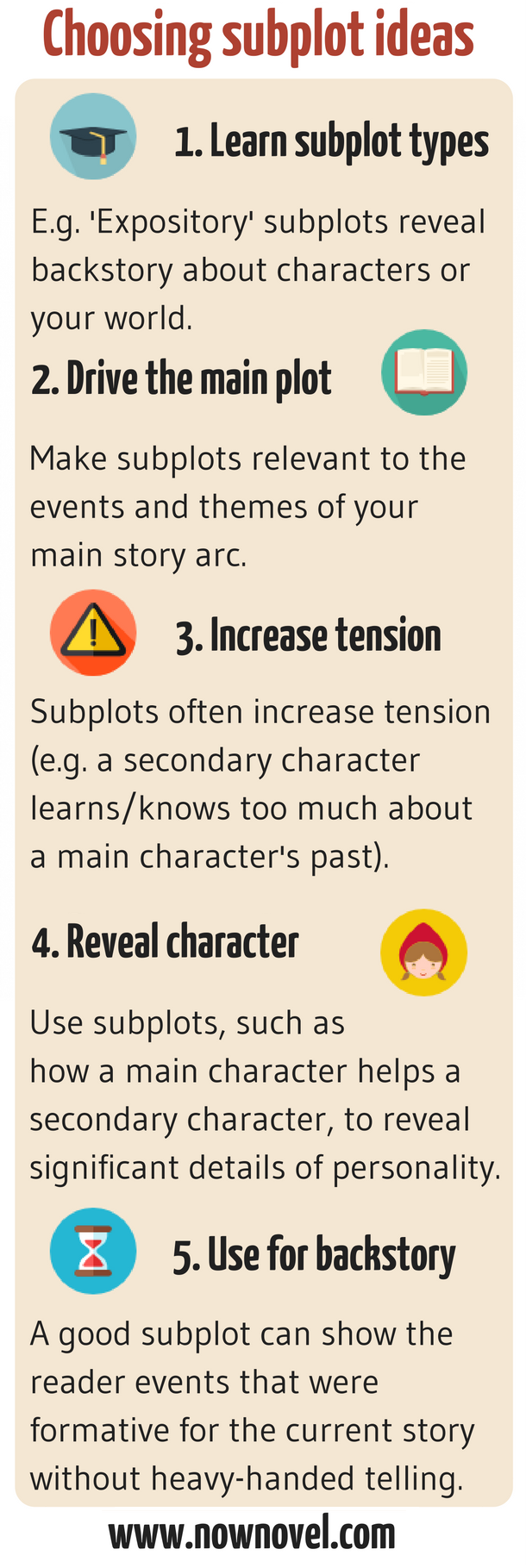
Here are 5 tips for choosing strong subplot ideas:
There are multiple types of subplots you may use. These include:
The type you choose will depend on your main story line. It should be relevant to the story. Pride and Prejudice with Zombies might be fun as a novelty. Yet if there are zombie subplots in your novel the reader can’t explain, they may be irritated (especially if they were looking for realist Regency romance).
Decide what subplot type would suit your story. When two characters are thrown into life-endangering work (for example, spying in a high-risk environment), close proximity and the need to release stress could spark a romantic subplot.
The best subplot ideas add intrigue and breadth to your story’s cast and world while alsodriving the main plot.
Take, for example, the subplot in Jane Austen’s Pride and Prejudice involving the protagonist Elizabeth’s youngest sister, Lydia. Lydia elopes with the charming George Wickham, who has no intention of marrying her (a truly scandalous event for those times). It is Elizabeth’s own (eventual) love interest, Mr. Darcy, who intervenes.
This romantic subplot performs a crucial function for the main plot. It shows Darcy’s decency, a trait that will endear him to the reader and Elizabeth Bennet.
Subplots also help keep narrative tension high. Particularly in suspenseful novels where there are mysteries that create an urgent need for resolution, subplots add more questions.
Some examples of subplots that increase tension:
Essentially, subplots that increase tension make us ask additional questions. The greater urgency of these questions, the greater the tension.
As mentioned above, in the subplot example from Pride and Prejudice, a subplot can reveal a central character’s more likable characteristics.
Subplots that reveal additional attributes of main characters like this are useful, as they give life and body to the cast of your novel without making all the action focus on your main characters.
They give secondary characters more important parts to play than simply being walk-on tragic figures, comic relief or conniving villains.
Subplots that reveal characters include subplots that show and develop:
For example, in a novel about an anti-hero like Dexter, a killer who eradicates society’s basest wrongdoers, the author could simply tell the reader the character’s backstory, what led them to this way of life.
Consider the alternative: There’s a subplot where a secondary character, suspicious of our anti-hero, tries to piece together his past. The backstory becomes a compelling mystery itself. We enjoy the added tension of wondering what will happen if the sleuthing character is caught trying to find out more. Ultimately, this is a more complex and satisfying approach to backstory and plot than simply having a narrator spell out every single incident preceding the main events of the story.
What is a subplot? It’s a secondary plot in a novel, play or movie. Subplots are the additional minor arcs that help develop characters, themes, and settings. Read 5 tips for writing subplots, including useful examples of subplots from books:
The main story arc in a novel is what the story’s action and character development orbit around. In the Harry Potter series, this is the inevitable conflict between Harry and the series’ villain, Lord Voldemort. In George R. R. Martin’s ‘A Song of Ice and Fire’ series, the main plot is the battle between Martin’s world’s inhabitants for the lands of Westeros.
These ‘grand’ story arcs are the main, thickest threads of narrative, but subplots add depth, detail, tension, and intrigue to the whole story. In Harry Potter, romantic subplots such as Harry’s growing relationship with a secondary character add romantic tension. The evolving situation at home with his cruel aunt and uncle adds depth and opposition.
In George R. R. Martin’s series, when the character Theon Greyjoy seizes Winterfell castle, subplots involving broken alliances and pacts add engrossing complications.
Subplots thus serve multiple plot purposes:
Here are 5 tips for choosing strong subplot ideas:
There are multiple types of subplots you may use. These include:
The type you choose will depend on your main story line. It should be relevant to the story. Pride and Prejudice with Zombies might be fun as a novelty. Yet if there are zombie subplots in your novel the reader can’t explain, they may be irritated (especially if they were looking for realist Regency romance).
Decide what subplot type would suit your story. When two characters are thrown into life-endangering work (for example, spying in a high-risk environment), close proximity and the need to release stress could spark a romantic subplot.
The best subplot ideas add intrigue and breadth to your story’s cast and world while alsodriving the main plot.
Take, for example, the subplot in Jane Austen’s Pride and Prejudice involving the protagonist Elizabeth’s youngest sister, Lydia. Lydia elopes with the charming George Wickham, who has no intention of marrying her (a truly scandalous event for those times). It is Elizabeth’s own (eventual) love interest, Mr. Darcy, who intervenes.
This romantic subplot performs a crucial function for the main plot. It shows Darcy’s decency, a trait that will endear him to the reader and Elizabeth Bennet.
Subplots also help keep narrative tension high. Particularly in suspenseful novels where there are mysteries that create an urgent need for resolution, subplots add more questions.
Some examples of subplots that increase tension:
Essentially, subplots that increase tension make us ask additional questions. The greater urgency of these questions, the greater the tension.
As mentioned above, in the subplot example from Pride and Prejudice, a subplot can reveal a central character’s more likable characteristics.
Subplots that reveal additional attributes of main characters like this are useful, as they give life and body to the cast of your novel without making all the action focus on your main characters.
They give secondary characters more important parts to play than simply being walk-on tragic figures, comic relief or conniving villains.
Subplots that reveal characters include subplots that show and develop:
For example, in a novel about an anti-hero like Dexter, a killer who eradicates society’s basest wrongdoers, the author could simply tell the reader the character’s backstory, what led them to this way of life.
Consider the alternative: There’s a subplot where a secondary character, suspicious of our anti-hero, tries to piece together his past. The backstory becomes a compelling mystery itself. We enjoy the added tension of wondering what will happen if the sleuthing character is caught trying to find out more. Ultimately, this is a more complex and satisfying approach to backstory and plot than simply having a narrator spell out every single incident preceding the main events of the story.